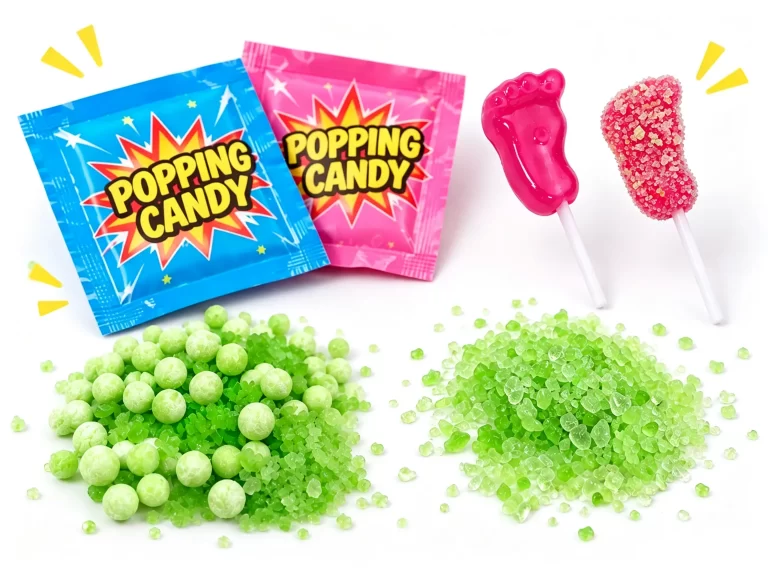

Pressed candy is a popular type of confectionery made by compressing prepared sugar powders or granules into solid shapes. Unlike hard candy, which is produced by cooking sugar syrup at high temperatures, pressed candy is mainly formed through mechanical pressure. This process allows manufacturers to create candies in different shapes, sizes, colors, and flavors.
For candy wholesalers, importers, and private-label brands, understanding the pressed candy manufacturing process can help them choose the right factory and evaluate product quality. It also helps buyers understand how ingredients, production equipment, and packaging affect the final product.
So, how are pressed candies made in a factory? The process usually includes ingredient preparation, mixing, granulation when needed, compression, quality inspection, and packaging. Each stage plays an important role in producing candies with consistent shapes, textures, and flavors.
Let’s look at how a professional candy factory makes pressed candy step by step.
What Ingredients Are Used to Make Pressed Candy?
Pressed candy starts with a carefully prepared formula. The ingredients affect the candy’s sweetness, hardness, flavor, color, and ability to hold its shape during compression.
Most pressed candies use sugar-based powders as their main ingredients. Manufacturers then add other materials to improve the texture, taste, and production performance. The exact formula depends on the product design and the requirements of the target market.
1. Main Sweetening Ingredients
Sugar and dextrose are common base ingredients in pressed candy. They provide sweetness and form the main structure of many tablet-style candies.
Some manufacturers also use glucose powder, maltodextrin, or other suitable sweeteners. These ingredients can change the sweetness level, powder flow, and texture of the finished candy.
2. Binding Ingredients
Binding ingredients help powder particles stay together after compression. Without suitable binding properties, the candy may break easily or fail to form properly.
Common binding materials include:
- Maltodextrin
- Gum arabic
- Starch-based binders
- Gelatin, where suitable for the product
The manufacturer selects the binder according to the formula and desired texture. Too little binding strength may produce fragile candies, while an unsuitable amount may affect the mouthfeel.
3. Flavors and Colors
Flavors and colors make pressed candy more attractive to consumers. Factories can use fruit flavors, mint flavors, milk flavors, and other options according to the product concept.
Food-grade colors can create different shades and color combinations. For example, a manufacturer can produce strawberry-flavored pink tablets, lemon-flavored yellow tablets, or mixed-color candy pieces.
4. Other Functional Ingredients
Some formulas include ingredients that improve processing or product performance. The following table lists common ingredients used in pressed candy formulations. Not all ingredients are required for every product, and the actual selection depends on the recipe and manufacturing process.
| Ingredient | Main purpose |
|---|---|
| Dextrose | Provides sweetness and forms the candy base |
| Maltodextrin | Supports texture and formulation |
| Gum arabic | Helps bind particles |
| Food-grade colors | Creates the desired appearance |
| Food flavors | Provides the required taste |
| Suitable lubricants | Helps reduce sticking during compression |
Why Does the Formula Matter?
A good formula must balance sweetness, texture, compressibility, and stability. The ingredients must work together during mixing and compression.
For example, a candy designed to dissolve quickly may need a different formulation from one designed to remain firm during handling and transportation.
At CSsweet, we consider the target market, candy shape, flavor, and packaging requirements when discussing customized pressed candy projects with buyers. This helps make sure that the product design matches the actual production conditions.
How Are Candy Ingredients Prepared Before Compression?
Ingredient preparation is one of the most important stages in pressed candy manufacturing. Before the powder enters the tablet press, the factory must make sure that the materials have suitable particle sizes, moisture levels, and mixing uniformity.
Poor preparation can cause uneven candy weights, weak tablets, inconsistent colors, and problems during compression.
1. Raw Material Inspection
The process begins with raw material inspection.
Factory staff check the incoming ingredients against purchasing specifications and production requirements. They review material names, batch information, packaging condition, and relevant quality documents.
Materials that do not meet the required specifications should not enter production.
2. Sieving and Powder Preparation
Some ingredients may contain large particles or small lumps. The factory uses sieving equipment to remove unwanted particles and improve powder uniformity.
If the original materials are too coarse, suitable grinding equipment may be used to achieve the required particle size.
This step helps the ingredients mix more evenly and flow more consistently during later processing.
3. Weighing and Mixing
After preparation, workers weigh each ingredient according to the approved formula.
The materials then enter a powder mixer. The mixer distributes the sweeteners, binders, colors, and flavors throughout the batch.
| Preparation step | Main purpose |
|---|---|
| Raw material inspection | Confirms material suitability |
| Sieving | Removes lumps and oversized particles |
| Grinding, if needed | Adjusts particle size |
| Accurate weighing | Controls the formula |
| Powder mixing | Improves ingredient distribution |
A consistent mixing process helps prevent differences in flavor, color, and composition between individual candies.
4. Granulation and Drying
Not every pressed candy requires granulation. Some suitable powders can go directly into a tablet press through direct compression.
However, certain formulas need granulation to improve powder flow and compressibility.
There are two common methods:
- Wet granulation: The factory adds a suitable binder liquid to the powder mixture. The material forms moist granules, which are then dried and screened.
- Dry granulation: The factory compacts the powder into larger pieces without adding a liquid binder. These pieces are then broken down into granules of a suitable size.
After granulation, the factory checks the particle size and moisture level. The prepared material should flow properly and feed evenly into the compression machine.
The choice of method depends on the raw materials and product requirements. Direct compression, dry granulation, and wet granulation are established approaches in tablet confectionery production.
Why Is Moisture Control Important?
Moisture affects how powder particles move and bond together.
Excessive moisture may cause sticking, poor powder flow, or inconsistent compression. Very dry materials may also have insufficient binding properties, depending on the formula.
Therefore, factories need to control moisture according to the specific ingredients and production process.
How Does a Tablet Press Shape Pressed Candy?
After ingredient preparation, the powder or granules move to the most important forming stage: compression.
A tablet press uses mechanical pressure to turn loose material into solid candy pieces. The machine contains feeding components, dies, and punches that work together to produce candies with consistent shapes and sizes.
1. Feeding the Prepared Material
The prepared powder or granules enter the feeding system of the tablet press.
The feeding system distributes the material into the dies. Each die receives a measured amount of material before compression.
Stable feeding is important because uneven filling can cause differences in candy weight and thickness.
2. Compression and Forming
Inside the tablet press, the upper and lower punches move toward each other. They apply pressure to the material inside the die cavity.
The pressure reduces the spaces between powder particles and helps them bond together.
The material then becomes a solid candy with the shape of the die.
Main components of a tablet press
| Component | Function |
|---|---|
| Hopper | Holds the prepared powder |
| Feeder | Transfers material into the dies |
| Die | Determines the candy’s basic shape and size |
| Upper punch | Applies compression from above |
| Lower punch | Supports the material and helps release the candy |
| Compression rollers | Control the compression force |
3. Creating Different Candy Shapes
One advantage of pressed candy production is its flexibility in shape design.
By changing the dies and punches, manufacturers can produce different candy shapes.
Common examples include:
- Round tablets
- Square candies
- Heart-shaped candies
- Star-shaped candies
- Animal-shaped candies
- Custom logo or character shapes
For private-label projects, buyers can discuss the desired shape, size, color, flavor, and surface design with the manufacturer.
However, not every shape is equally easy to produce. Very thin designs, sharp edges, or complicated patterns may require special tooling and production trials.
4. Controlling Compression Pressure
Compression pressure affects the finished candy’s hardness, density, and ability to remain intact during handling.
If the pressure is too low, the candy may become fragile and break easily. If the pressure is unsuitable for the formula, the candy may develop cracks or other forming defects.
Manufacturers need to adjust the machine according to the product specifications.
The factory should also check whether the candy releases smoothly from the dies. Sticking, capping, and inconsistent tablet weights are common issues that require attention during compression.
What Machines Are Used to Make Pressed Candy?
A typical pressed candy production line may include several types of equipment.
| Machine | Main function |
|---|---|
| Grinder | Reduces the size of raw materials |
| Vibrating sieve | Separates particles by size |
| Powder mixer | Mixes different ingredients |
| Granulator | Produces suitable granules when needed |
| Dryer | Removes excess moisture from wet granules |
| Tablet press | Compresses powder into candy shapes |
| Metal detector | Helps identify metal contamination |
| Packaging machine | Packs the finished products |
The exact equipment configuration depends on the formula, production capacity, and product design.
How Do Factories Inspect and Package Pressed Candy?
Compression does not mean the production process is finished. The factory still needs to inspect the candies and prepare them for storage, transportation, and sale.
Quality inspection helps identify defects before the products enter their final packaging.
1. Appearance Inspection
The factory checks whether the candies have the correct shape, color, and surface condition.
Common defects include:
- Cracked or broken edges
- Uneven surfaces
- Incorrect shapes
- Color differences
- Sticking or damaged pieces
The factory should remove defective products according to its quality procedures.
2. Weight and Size Inspection
Candy weight and dimensions are important for product consistency.
Operators take samples during production and check whether the pieces meet the approved specifications.
| Quality item | What the factory checks |
|---|---|
| Individual weight | Whether the candy meets the target weight |
| Diameter and thickness | Whether the dimensions are consistent |
| Hardness | Whether the candy has suitable strength |
| Appearance | Whether cracks or surface defects exist |
| Flavor | Whether the taste matches the approved sample |
| Friability | Whether the candy breaks or loses material too easily |
Hardness and friability are particularly important for pressed candy. A candy should be firm enough to withstand handling, but it should also provide the intended eating experience.
3. Flavor and Texture Testing
The factory also evaluates the candy’s taste and texture.
Depending on the product, quality staff may check sweetness, flavor consistency, mouthfeel, and how the candy dissolves.
For customized products, the factory should compare production samples with the buyer-approved reference sample.
This step helps reduce differences between sample approval and mass production.
4. Packaging the Finished Candy
After inspection, the qualified candies move to the packaging stage.
Different packaging options can serve different markets and sales channels.
Common packaging options include:
| Packaging type | Suitable applications |
|---|---|
| Individual sachets | Convenience stores and promotional products |
| Small bags | Retail candy products |
| Plastic bottles | Tablet candy and mint products |
| Stand-up pouches | Supermarkets and online retail |
| Bulk packaging | Wholesale and further repacking |
Packaging materials should protect the candy from moisture and contamination. The factory also checks sealing quality, package appearance, label information, and batch identification.
For international orders, buyers should confirm the packaging language, ingredient declaration, net weight, barcode, and other market-specific label requirements before mass production.
How Can Buyers Ensure Consistent Product Quality?
Buyers should not evaluate a pressed candy supplier only by looking at the product sample.
They should also ask about the factory’s production process and quality management system.
Here are several useful questions:
- Does the factory have suitable powder mixing and compression equipment?
- Can the manufacturer produce the required candy shapes and sizes?
- How does the factory control candy weight and hardness?
- Does the factory inspect products during production?
- Can the manufacturer provide samples before mass production?
- Can the factory support customized packaging and private-label orders?
At CSsweet, we understand that overseas buyers need more than a finished candy product. They also need reliable production, consistent quality, and suitable packaging for their markets.
We can discuss pressed candy shapes, flavors, colors, packaging, and OEM/ODM requirements according to individual project needs. Buyers can also confirm samples and product specifications before moving forward with larger orders.
Conclusion
Pressed candy manufacturing involves several important stages, from raw material preparation and powder mixing to compression, inspection, and packaging.
The quality of the final candy depends on the formulation, particle size, moisture control, compression settings, and production inspection. Each stage needs proper control to ensure consistent product quality.
For wholesalers, importers, and private-label brands, understanding these steps makes it easier to evaluate manufacturers and communicate product requirements.
If you are planning to develop customized pressed candy products, working with an experienced manufacturer can help turn your product ideas into suitable commercial products.